
 One Act of Mercy Global
- October 7, 2026
 One Act of Mercy Global
Recovering from addiction is rarely as simple as deciding to stop using alcohol or drugs.
For many people, addiction affects much more than substance use. It can affect relationships, physical health, emotional wellbeing, family life, work, finances and a person’s sense of purpose.
That is why meaningful recovery may require more than one form of support.
Counselling, medical care, nutrition, rehabilitation and continued social support can each play an important role in helping a person move towards recovery.
In Kenya, substance-use disorders remain an important public-health concern, and national guidance recognizes the need for structured approaches to assessment, treatment and recovery.
But behind every discussion about addiction is a person—and often a family—trying to find a way forward.
This article explains what addiction recovery can involve, why counselling matters, when rehabilitation may be necessary, and how nutrition and community support can contribute to the recovery journey.
What Is Addiction?
Addiction can involve continued use of a substance or repeated engagement in a behaviour despite harmful consequences.
A person may understand that something is causing problems and still find it difficult to stop.
This is one reason it can be unhelpful to describe addiction simply as a lack of discipline or willpower.
Addiction can involve complex physical, psychological, behavioural and social factors.
Depending on the individual, these may include:
- Alcohol or drug use
- Emotional or psychological difficulties
- Trauma or difficult life experiences
- Relationship problems
- Social pressures
- Environmental influences
- Withdrawal symptoms
- Repeated patterns of harmful behaviour
- Difficulty managing stress or emotions
Because the circumstances are different for every person, recovery should also be approached according to the person’s needs.
Why Is Addiction Recovery Difficult?
One of the most difficult things for families to understand is why someone continues using a substance even when the consequences are obvious.
They may have lost employment.
They may have damaged important relationships.
They may have experienced health problems.
They may have promised to stop several times.
Yet the cycle continues.
This does not necessarily mean that the person does not care.
Addiction can create powerful patterns that are difficult to break without appropriate support.
The person may also experience cravings, withdrawal symptoms, emotional distress or situations that trigger continued substance use.
For this reason, simply telling someone to “just stop” may not address the underlying problem.
Recovery often requires understanding why the addiction developed, what maintains it, and what support the person needs to change the pattern.
The Role of Addiction Counselling
Counselling can be an important part of addiction recovery.
It provides a structured environment where a person can explore their relationship with alcohol, drugs or other harmful behaviours and begin working towards change.
Addiction counselling may help a person:
- Understand their patterns of substance use
- Identify situations that trigger use
- Explore thoughts and emotions connected to addiction
- Develop healthier coping strategies
- Address relationship difficulties
- Strengthen motivation for recovery
- Prepare for challenges that may arise during recovery
- Work towards maintaining positive changes
Counselling can also provide a space where the person is listened to without reducing them to their addiction.
At One Act of Mercy Global, addiction counselling is one of the Clinic’s core services, alongside drug assessment and testing, individual counselling, group therapy and other mental-health services.
Why Assessment Matters
Before deciding what kind of intervention someone needs, it is important to understand their situation.
Two people who appear to have similar substance-use problems may require very different forms of support.
A professional assessment may consider factors such as:
- What substance is being used
- How frequently it is being used
- How long the person has been using it
- Physical and psychological effects
- Previous attempts to stop
- Withdrawal experiences
- Family and social circumstances
- Other mental-health concerns
- The person’s current level of functioning
This is why drug assessment and testing can be an important part of identifying appropriate support.
Assessment should not be about labelling or judging someone.
It should help inform the next step.
When Is Rehabilitation Necessary?
Not everyone experiencing addiction will require residential rehabilitation.
However, some people may need a more structured environment because their substance use is severe, their home environment makes recovery difficult, or previous attempts to stop have not been successful.
Rehabilitation may provide a structured setting where an individual can receive appropriate treatment and support while working towards recovery.
The decision about whether rehabilitation is appropriate should be made through proper professional assessment.
It should not be based simply on how severe the situation appears to someone outside the person’s care team.
Rehabilitation may be considered when:
- Substance use has become difficult to control.
- Previous attempts at recovery have repeatedly failed.
- The person’s environment makes recovery particularly difficult.
- There are serious physical or psychological consequences.
- The person requires a structured recovery environment.
- Additional professional treatment and monitoring are needed.
The right intervention depends on the individual’s circumstances.
Recovery Is More Than Stopping Substance Use
Stopping alcohol or drug use is an important part of recovery.
But sustainable recovery often involves addressing what comes next.
A person may need to rebuild relationships.
They may need to develop healthier routines.
They may need to learn new ways of managing stress.
They may need support returning to work or education.
They may need to reconnect with family or community.
They may need help addressing physical or mental-health concerns.
This is why recovery should not be viewed as a single event.
Recovery is a process.
The goal is not simply to remove a substance from someone’s life, but to help the person build healthier ways of living.
Why Nutrition Matters During Addiction Recovery
Nutrition is another important consideration during recovery.
Substance use can affect appetite, eating patterns, physical wellbeing and a person’s ability to maintain a balanced diet.
During recovery, providing nourishing food can therefore form part of broader supportive care.
Good nutrition does not replace addiction treatment or counselling.
Rather, it can complement other forms of support by helping people maintain their physical wellbeing as they work through recovery.
This is particularly important for people who have experienced prolonged periods of poor nutrition or unstable eating patterns.
Lishe Bora Kwa Jamii Initiative
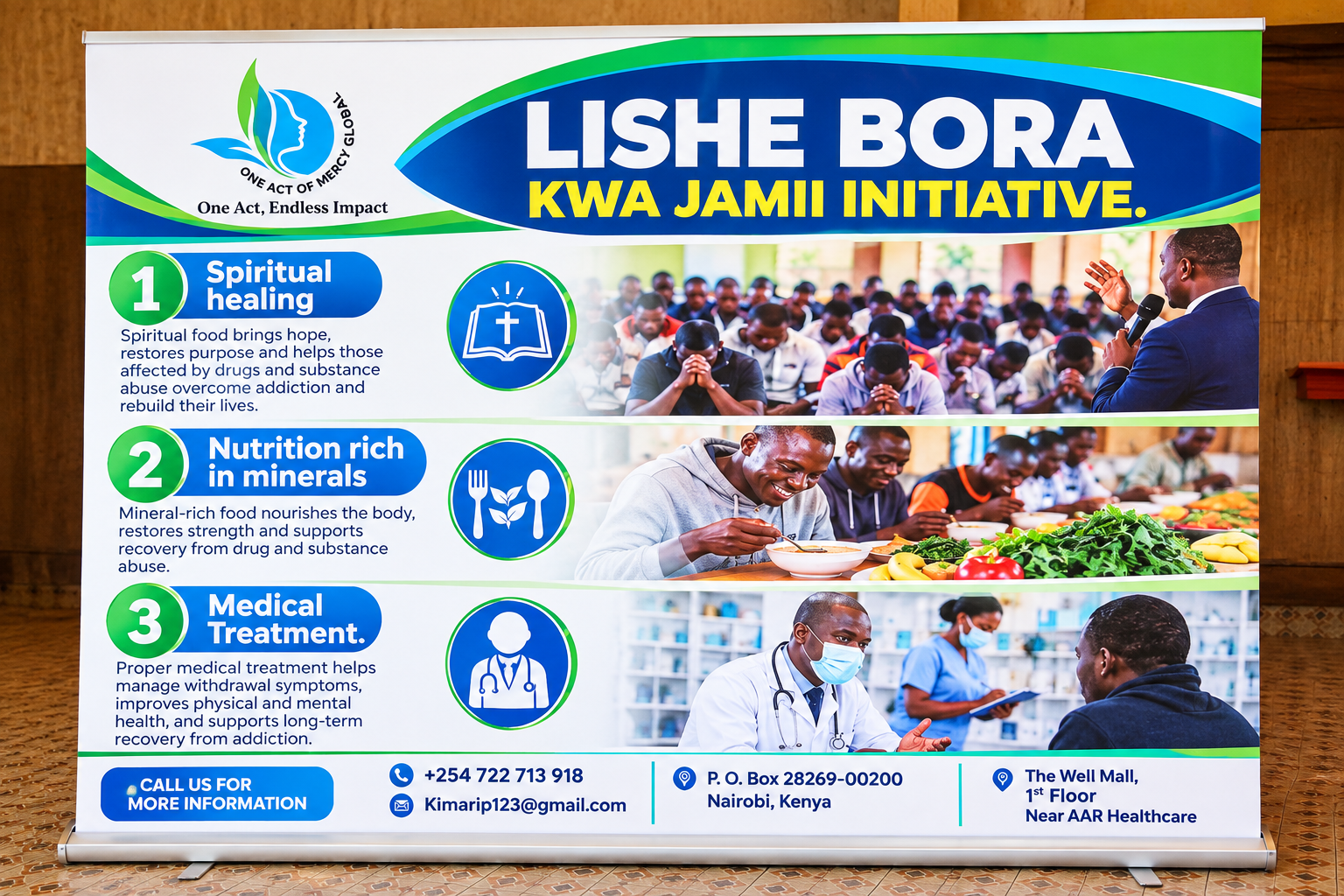
At One Act of Mercy Global, nutrition support is connected to addiction recovery through the Lishe Bora Kwa Jamii Initiative, a programme under the One Act of Mercy Counselling Clinic.
The initiative supports registered people recovering from alcoholism and addiction by providing nutritious meals and porridge.
The programme purchases cereals including:
- Noe
- Njahi
- Mbaazi
- Thoroko
- Chickpeas
- Gituru
- Maize
Meals are prepared for registered recoverees to collect at designated locations.
Porridge is also prepared using ingredients including:
- Millet
- Sorghum
- Fish flour
- Groundnuts
The purpose is practical: to provide nutritional support to people who are going through the recovery journey.
Nutrition, Medical Care and Recovery Work Together
Nutrition should not be considered a replacement for medical treatment or counselling.
Instead, recovery can involve several areas of support working together.
Counselling
Helps address psychological, emotional, behavioural and personal aspects of recovery.
Medical Treatment
Can address physical and mental-health needs and help manage appropriate aspects of substance-use treatment.
Nutrition
Supports the person’s physical wellbeing during the recovery journey.
Rehabilitation
May provide a structured environment for people who require a higher level of support.
Social and Community Support
Can help people reconnect with supportive relationships and build healthier lives.
These areas are not necessarily separate.
For some people, successful recovery may require several forms of support at different stages.
What Role Does the Family Play in Addiction Recovery?
Addiction affects families too.
Parents may feel helpless.
Partners may feel betrayed or exhausted.
Children may experience confusion or instability.
Siblings may not know whether to help, confront the person or step away.
Family members can therefore need support themselves.
One of the most useful things a family can do is avoid reducing the person to their addiction.
At the same time, supporting someone does not mean ignoring harmful behaviour.
Healthy support can involve:
- Encouraging professional help
- Setting appropriate boundaries
- Avoiding unnecessary judgement
- Supporting treatment plans
- Encouraging healthy routines
- Learning about addiction
- Taking care of their own emotional wellbeing
Family counselling may also be appropriate when addiction has created conflict, communication problems or other relationship difficulties.
What If Someone Refuses Help?
This can be one of the most painful situations for a family.
You may see that someone is struggling while they do not believe they need help.
Arguing, threatening or repeatedly confronting them may not produce the outcome you want.
Instead, consider encouraging a conversation about support rather than blame.
You can express concern without attacking the person’s character.
For example:
“We are concerned about what you are going through, and we would like to help you find professional support.”
The specific approach will depend on the person’s circumstances and level of risk.
If someone is in immediate danger or experiencing a medical emergency, seek urgent professional or emergency assistance.
Addiction Recovery Requires Dignity
People experiencing addiction are sometimes described using labels that reduce them to their condition.
That can reinforce stigma and make it harder for people to seek help.
A more constructive approach is to recognise that addiction can be a serious health and behavioural challenge while still treating the person with dignity.
Recovery can involve setbacks.
It can involve difficult conversations.
It can take time.
And progress may not always be linear.
What matters is creating pathways towards appropriate support.
How Do You Know Where to Start?
If you or someone close to you is struggling with alcohol or drug use, the first step does not have to be deciding whether they need rehabilitation.
Start by seeking a professional assessment.
A qualified professional can help you understand the situation and determine what type of support may be appropriate.
Depending on the circumstances, this could involve:
Assessment → Counselling → Medical support → Rehabilitation → Nutrition → Continued recovery support
Not everyone will follow the same path.
The important thing is to avoid trying to manage a serious addiction entirely without professional guidance.
Addiction Recovery in Kenya Needs Community Support
Addiction does not happen in isolation.
It affects families, workplaces, schools, communities and social relationships.
That means recovery support also has an important community dimension.
Mental-health and addiction services become more meaningful when people can access appropriate support without being pushed away by stigma, shame or lack of information.
Kenya’s Ministry of Health has developed national resources addressing mental health and substance-use disorders, including the National Protocol for Treatment of Substance Use Disorders in Kenya. The Ministry has also emphasised strengthening community-based and accessible mental-health services.
This is why organisations, professionals, families, volunteers and donors all have different roles to play.
How You Can Support Someone in Recovery
If someone you know is recovering from addiction, your support can be valuable.
You can:
Encourage Professional Support
Help the person connect with appropriate counselling, assessment or medical care.
Create a Supportive Environment
Encourage healthy routines and reduce unnecessary situations that may undermine recovery.
Listen
Sometimes people need someone who will listen without immediately judging them.
Respect Professional Guidance
If the person is receiving treatment, encourage them to follow the recommendations of their healthcare and counselling team.
Support Healthy Nutrition
Where appropriate, helping someone maintain access to nourishing food can complement their broader recovery plan.
Look After Yourself
Supporting someone with addiction can be emotionally demanding. Family members also need support and healthy boundaries.
How Donors Can Support Addiction Recovery
Recovery support also requires resources.
For some families, the cost of rehabilitation, counselling, medical care, food and other necessities can create significant barriers.
This is where responsible community giving can make a practical difference.
At One Act of Mercy Global, supporters can contribute towards initiatives that address different aspects of recovery.
These include the Rehabilitation Support Fund, which seeks support for placing severely affected addiction victims into appropriate rehabilitation, and the Lishe Bora Kwa Jamii Initiative, which provides nutritional support to registered recoverees.
Your support can therefore contribute to more than a single moment.
It can help create access to the support surrounding recovery.
Frequently Asked Questions About Addiction Recovery
Can someone recover from addiction?
Yes. Recovery is possible, although the journey can be different for every person. Appropriate treatment and ongoing support can help people work towards recovery and maintain healthier patterns of living.
Does addiction counselling really help?
Counselling can be an important part of addiction treatment. It can help people understand their substance-use patterns, identify triggers, develop coping strategies and work towards behavioural change.
Does everyone with addiction need rehabilitation?
No. Rehabilitation is not automatically necessary for everyone. The appropriate level of care depends on the person’s circumstances and should be determined through appropriate professional assessment.
Why is nutrition important during addiction recovery?
Addiction can be associated with poor eating patterns and physical health challenges. Providing nutritious food can support physical wellbeing as part of broader recovery support, although nutrition does not replace addiction treatment.
What is Lishe Bora Kwa Jamii?
Lishe Bora Kwa Jamii is a programme under the One Act of Mercy Counselling Clinic that provides nutritional support to registered people recovering from alcoholism and addiction.
How can I help a family member with addiction?
Encourage professional support, listen without unnecessary judgement, maintain appropriate boundaries and support healthy routines. If there is an immediate medical or safety emergency, seek urgent professional assistance.
What should I do if someone is experiencing severe withdrawal?
Do not attempt to manage potentially serious withdrawal symptoms on your own. Seek professional medical advice. Some forms of withdrawal can require medical monitoring and treatment.
Can addiction and mental-health problems occur together?
Yes. A person can experience both substance-use problems and mental-health difficulties. Professional assessment can help determine the appropriate combination of support.
Where to Find Addiction Counselling in Kenya
If you are looking for addiction counselling in Kenya, the first step is finding professional support that can understand the person’s individual circumstances.
One Act of Mercy Global provides services including:
- Drug Assessment and Testing
- Addiction Counselling
- Individual Counselling
- Group Therapy
- Family Counselling
- Mental Health Awareness
- Psycho-Social Education
The Clinic also supports different age groups and life stages through adolescent and young adult counselling, adult counselling, elderly counselling and perinatal mental-health support.
For someone experiencing addiction, the appropriate starting point may be assessment, counselling or referral depending on their circumstances.
Recovery Starts With Support
Addiction can change a person’s life and affect everyone around them.
But addiction does not have to define a person’s future.
Counselling can address the psychological and behavioural aspects of recovery.
Medical care can address health needs.
Rehabilitation can provide structured support when necessary.
Nutrition can support physical wellbeing.
Families and communities can provide connection and encouragement.
Together, these forms of support can create a stronger foundation for recovery.
If you or someone you care about is struggling with alcohol, drugs or harmful behaviours, consider taking the first step by seeking professional support.
You Don’t Have To Face Recovery Alone.
Talk to One Act of Mercy Global about counselling, addiction support and available recovery services.
About One Act of Mercy Global
One Act of Mercy Global provides professional counselling, mental-health and addiction-related services for individuals, families and communities.
Through the One Act of Mercy Counselling Clinic, the organisation provides services including individual counselling, couples counselling, family counselling, group therapy, addiction counselling, drug assessment and testing, mental-health awareness and psychosocial education.
The Lishe Bora Kwa Jamii Initiative operates as a programme under the Clinic, providing nutritional support to registered people recovering from alcoholism and addiction.
One Act, Endless Impact.